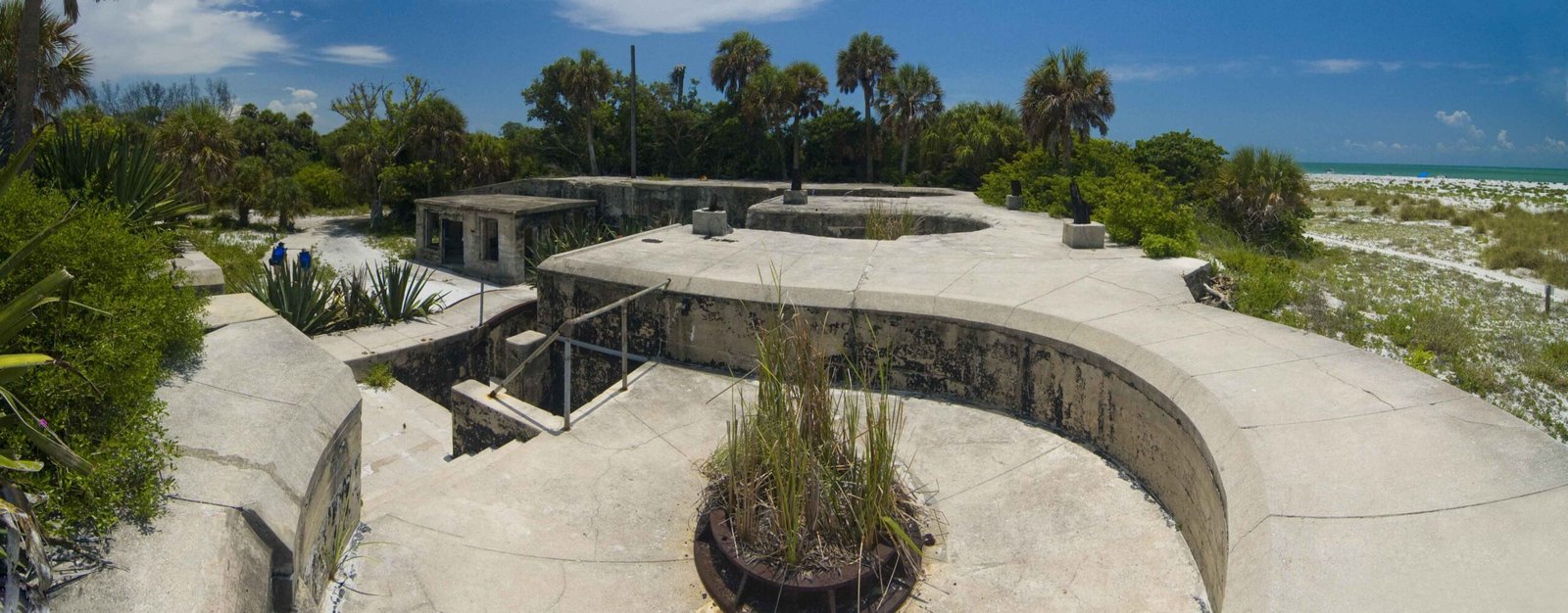
Located on Egmont Key at the mouth of Tampa Bay, Fort Dade once served as a strategic military installation designed to protect Florida’s coastline. Established in the late 19th century, the fort supported soldiers, families, and civilian staff in a small but active island community.
Today, the brick structures and artillery batteries remain — weathered by salt air and time — standing as one of Florida’s most visually striking abandoned military sites.
To understand why Fort Dade was built — and why it was ultimately abandoned — you have to look at Florida’s coastal defense history and the shifting priorities of national security.
Where Is Fort Dade Located?
Fort Dade is located on Egmont Key, a barrier island at the entrance to Tampa Bay. The island sits between Pinellas County and Manatee County and has historically served as a strategic defensive point controlling access to the bay.
Because of its position, Egmont Key became an ideal site for coastal artillery installations during periods of military tension.
Today, Egmont Key is part of a state park and wildlife refuge, accessible primarily by boat or ferry.
Why Fort Dade Was Built
Construction of Fort Dade began in the 1890s during a period when the United States was strengthening coastal defenses following the Spanish-American War. Military planners recognized Tampa Bay as a vital port that required protection from potential naval threats.
The fort included:
• Artillery batteries
• Barracks
• Support buildings
• Hospitals
• Infrastructure for military families
At its peak, Fort Dade functioned as a self-contained military community, housing soldiers and civilians who maintained defensive operations.

Life on Egmont Key
Life at Fort Dade extended beyond military drills and coastal surveillance. The island included family housing, a school, and recreational facilities. Soldiers’ families formed a small community shaped by isolation and service.
Despite its remote setting, Egmont Key supported daily routines typical of small towns — education, medical care, and community interaction.
However, the island’s isolation also presented logistical challenges, particularly during severe weather and supply disruptions.
Why Fort Dade Was Abandoned
Following World War I, advancements in military technology reduced the strategic importance of coastal artillery forts. Aircraft, naval modernization, and changing defense strategies made fixed artillery installations less critical.
By the 1920s, Fort Dade’s active military role diminished significantly. The post was eventually decommissioned, and military personnel withdrew.
Without its strategic function, the island settlement could not sustain itself. Buildings were left behind, and Egmont Key transitioned away from active defense operations.
What Remains Today
Today, visitors to Egmont Key can still see:
• Brick barracks
• Artillery battery remains
• Ruins of support structures
• Lighthouse installations
The structures have deteriorated but remain largely intact, offering a rare glimpse into Florida’s military past.
Because the site is preserved as part of a state park, it stands as one of the more accessible abandoned military communities in Florida.
Can You Visit Fort Dade?
Yes, Egmont Key is accessible by boat and ferry services departing from Fort De Soto and surrounding areas. However, visitors should be aware that the island is also a protected wildlife habitat.
While the ruins are visible, preservation rules apply, and climbing on fragile structures is discouraged.
Fort Dade in the Context of Florida’s Ghost Towns
Fort Dade differs from industrial company towns like Brewster, but it reflects a similar pattern: a community built around a single purpose.
When that purpose ended, the settlement declined.
Like many Florida ghost towns, Fort Dade demonstrates how economic or strategic shifts can erase entire communities within a generation.
Leave a Reply